I was reading this blogpost by Annie-Murphy Paul when I suddenly recognized a figure from a very old post on this blog on neat percentages, the 70-20-10 rule. The basis idea is: We would only learn 10% from the formal learning situation, 20% through others and 70% through experience and practice.
In the research mentioned in the blogpost they cite research that “…reported that the day after training, trainees exhibit little to no skill decay, but 1 year after training, trainees have lost over 90% (the research actually mentions 92%, PDB) of what they learned. Among factors found by Arthur et al. to affect retention levels was the nature of the task (greater retention for closed-loop vs. open-loop tasks; greater decay for cognitive vs. physical tasks). Most important, Arthur et al. also reported that overall retention decreases dramatically with longer periods of nonuse or practice.” You can download the research here.
Still wait, this is not the same as learning less in formal learning situations, the percentage is closer to what people tend to forget when not using the skills learned in the formal training. So, this is closer to a very old curve by Ebbinghaus who described a possible forgetting curve. This forgetting curve “…hypothesizes the decline of memory retention in time. This curve shows how information is lost over time when there is no attempt to retain it.’ (source)
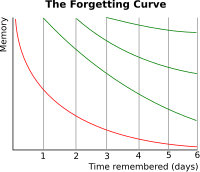
If you read somewhere people have forgotten 90 percent of what they learned in school, this is most of the time the original source of that idea. If we look at the meta-research on skills training mentioned earlier, their forgetting curve is actually much more gentle on the effect of training than the Ebbinghaus forgetting curve (probably because Ebbinghaus focused on non-relevant information).
But the main insight is: you tend to forget things you’ve learned and don’t use. This doesn’t mean you only lear 10% from formal learning situations, but you will forget 90% if you never use what you’ve learned.