Yesterday Wouter Duyck already shared this study on Twitter. In a first study, the researchers discovered that restrictive school policies don’t lead to lower phone and social media use or
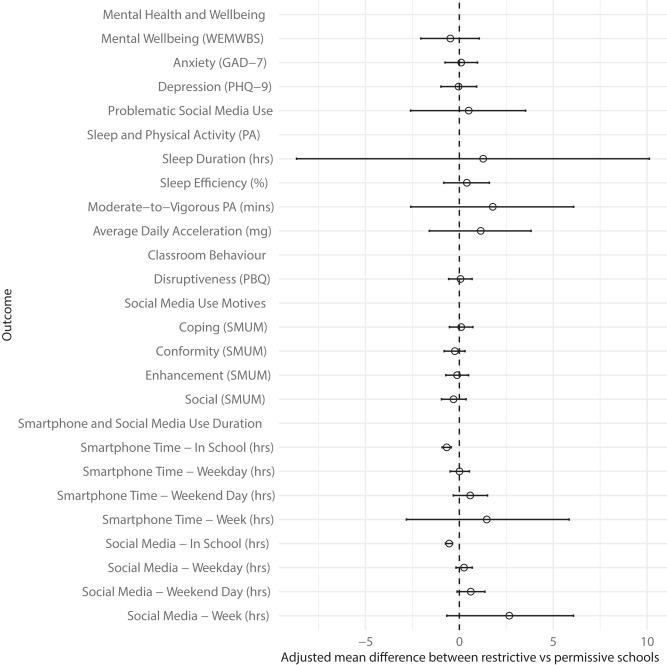
From the press release:
Students attending schools that ban the use of phones throughout the school day aren’t necessarily experiencing better mental health and wellbeing, as the first worldwide study of its kind has found that just banning smartphones is not enough to tackle their negative impacts.
In a landmark study published today (Wednesday 5 Feb) in Lancet Regional Health Europe, 1227 students from 30 schools across England provided data about smartphone and social media usage and a range of mental health, wellbeing and other outcomes. Among the schools that took part in the study, 20 had various forms of restrictive phone policies in place.
The study, which was funded by the National Institute for Health and Care Research (NIHR), found that there was no difference in outcomes for students who attend schools that ban smartphones throughout the school day, including:
- Mental wellbeing, anxiety and depression
- Physical Activity and Sleep
- Educational Outcomes — English and Maths attainment and levels of disruptive classroom behaviour
Smartphone bans in schools did lead to a slight decrease in students using phones (of approximately 40 minutes) and social media (approx. 30 minutes) in school, but the study suggests that the impact is small and that school policies banning recreational phone use didn’t lead to a meaningful reduction in the overall time spent using phones and social media.
Dr Victoria Goodyear, Associate Professor at the University of Birmingham and lead author of the study said:
“This is the first worldwide study of its kind to evaluate the impact of school phone policies on adolescent mental health and wellbeing, and other health and educational outcomes.
“We did find a link between more time spent on phones and social media and worse outcomes, with worse mental wellbeing and mental health outcomes, less physical activity and poorer sleep, lower educational attainment and a greater level of disruptive classroom behaviour.
“This suggests that reducing this time spent on phones is an important focus. But we need to do more than focus on schools alone, and consider phone use within and outside of school, across a whole day and the whole week.”
Data from students was collected more than a 12-month period ending in November 2023 from 20 schools with restrictive phone policies and 10 schools with permissive policies, where a phone could be used at breaks, lunch or in certain zones (such as outside areas). The 2:1 ratio of restrictive and permissive schools was used, as among schools in the study sampling area, the majority (n=1245) had restrictive policies while few (n=96) had permissive policies.
Health and related outcomes included validated measures of mental wellbeing, anxiety and depressive symptoms, educational attainment in English and Maths, and disruptive classroom behaviour, and objective measures of physical activity and sleep.
Among all students in both permissive and restrictive policy schools, smartphone use was on average between 4-6 hours per day.
Professor Miranda Pallan from the University of Birmingham, and a senior author of the paper said:
“Our study suggests that school policies are not the silver bullet for preventing the detrimental impacts of smartphone and social media use.
“The paper shows that restrictive policies on recreational phone use in schools do not lead to better outcomes among students, but that addressing overall phone use should be a priority for improving health and wellbeing among adolescents.”
Abstract of the study:
Background
Poor mental health in adolescents can negatively affect sleep, physical activity and academic performance, and is attributed by some to increasing mobile phone use. Many countries have introduced policies to restrict phone use in schools to improve health and educational outcomes. The SMART Schools study evaluated the impact of school phone policies by comparing outcomes in adolescents who attended schools that restrict and permit phone use.Methods
We conducted a cross-sectional observational study with adolescents from 30 English secondary schools, comprising 20 with restrictive (recreational phone use is not permitted) and 10 with permissive (recreational phone use is permitted) policies. The primary outcome was mental wellbeing (assessed using Warwick–Edinburgh Mental Well-Being Scale [WEMWBS]). Secondary outcomes included smartphone and social media time. Mixed effects linear regression models were used to explore associations between school phone policy and participant outcomes, and between phone and social media use time and participant outcomes. Study registration: ISRCTN77948572.Findings
We recruited 1227 participants (age 12–15) across 30 schools. Mean WEMWBS score was 47 (SD = 9) with no evidence of a difference between groups (adjusted mean difference −0.48, 95% CI −2.05 to 1.06, p = 0.62). Adolescents attending schools with restrictive, compared to permissive policies had lower phone (adjusted mean difference −0.67 h, 95% CI −0.92 to −0.43, p = 0.00024) and social media time (adjusted mean difference −0.54 h, 95% CI −0.74 to −0.36, p = 0.00018) during school time, but there was no evidence for differences when comparing usage time on weekdays or weekends.Interpretation
There is no evidence that restrictive school policies are associated with overall phone and social media use or better mental wellbeing in adolescents. The findings do not provide evidence to support the use of school policies that prohibit phone use during the school day in their current form, and indicate that these policies require further development.